Shelter Medicine Program

The Shelter Medicine Program

The Shelter Medicine Program empowers CVM students to apply their developing skills in collaboration with experienced veterinary professionals, providing compassionate care to the animals most in need.

Thousands of puppies and kittens are born in the United States every day. Only some are able to find loving owners to care for them. What happens to the rest?

The Mississippi State University College of Veterinary Medicine is lending them a helping hand. Through our Humane Ethics and Animal Welfare Program, many animals are receiving the veterinary care they need to ensure their good health and to increase their chances of adoption.

In addition, as a result of this Program, our graduates are leaving the College with a keen understanding of pet overpopulation issues and the skills required to address them.
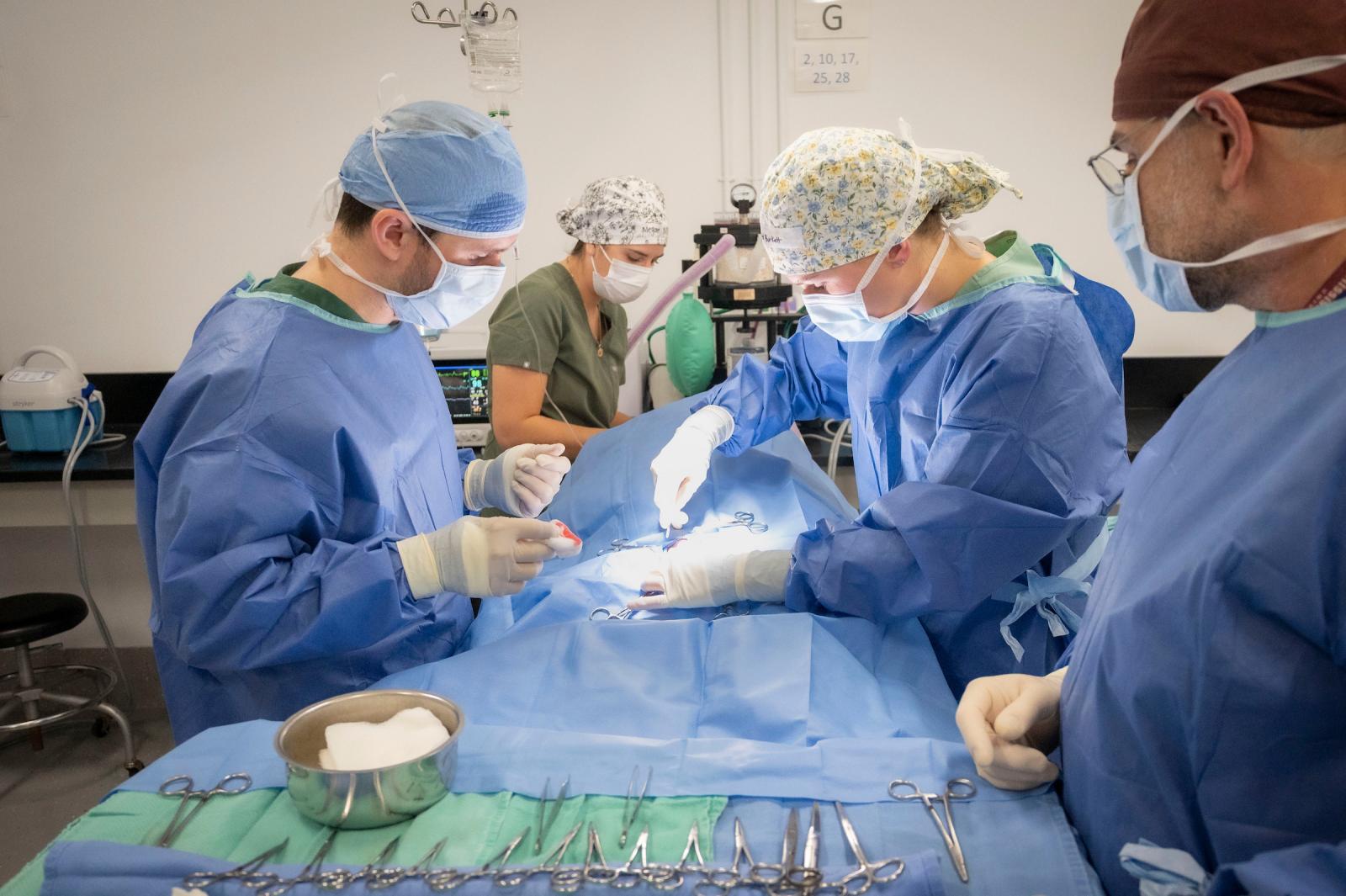
Surgeons working to help a dog.

The Shelter Medicine Program works with over 2 dozen partners across the state, ranging from traditional brick-and-mortar animal shelters to purely foster-based transport organizations. All of the Program’s partners are valued for their commitment to animal rescue and the role they play in animal welfare. To inquire about becoming a rescue partner, please email sheltermed@msstate.edu.

MSU CVM has had a cooperative program with Mississippi animal shelters since the 1990s, but the Shelter Medicine Program took off in 2007 when we acquired our first mobile veterinary unit. Though the mobile unit is no longer used to travel, it is located alongside the Shelter Medicine stationary clinic. The mobile unit and stationary clinic (lovingly nicknamed the "Stay and Spay") allow the Program to expand its service to more rescue partners and further improve the student experience.

Since 2007, approximately 100,000 spay/neuter surgeries have been performed through our Shelter Medicine Program, greatly increasing these animals’ chances of adoption and preventing scores of additional litters of unwanted animals. In addition, about 1,100 new veterinarians have entered the workforce well prepared to reduce pet overpopulation and improve adoption rates stateside as well as abroad.

Perhaps one of the most impressive aspects of the MSU CVM Shelter Medicine Program is that it has been almost entirely funded by grants and donations.
"Proudly Supported by: Petco Love"The MSU CVM Shelter Medicine Program is proudly supported by Petco Love, which recently provided a $25,000 grant as part of #SpayTogether, a collaborative, historical initiative of several national funders and organizations who have come together with a goal to help organizations catch up on spay/neuter services. 

For additional information about the MSU CVM Shelter Medicine email us at sheltermed@msstate.edu.

To make a gift to help support the program, contact MSU CVM Development Director Jimmy Kight at (662) 325-5893 or jkight@foundation.msstate.edu.

Who Can Be Seen at the SMPCC?

The SMPCC will provide veterinary care only for animals legally in the custody of approved MSU CVM Shelter Medicine partner organizations.

The SMPCC is not open to the general public, and privately owned animals cannot be seen at the clinic. This includes personal animals belonging to MSU faculty, staff, and students.

Animals also cannot be surrendered or transferred to a shelter or rescue organization for the purpose of accessing SMPCC services and then returned to the original owner.

How Does the SMPCC Relate to the Animal Health Center?

The SMPCC and the Animal Health Center are separate clinical services serving different patient populations.

There will be no direct referral or transfer pathway between the AHC and the SMPCC in either direction. A privately owned animal being seen at the AHC cannot be referred or transferred to the SMPCC for lower-cost care. Good Samaritan animals cannot be transferred or brought to the SMPCC.

There will be no direct consultation services between the AHC and the SMPCC.

Likewise, if a shelter or rescue animal being seen through the SMPCC needs care beyond what we can provide, the shelter or rescue organization will be responsible for arranging that care with a veterinary provider of its choosing. If the organization independently chooses to pursue care through the AHC, the animal will enter the AHC as a regular patient and be subject to the AHC's normal scheduling, policies, and fees.

We made a strong commitment to our local veterinarians that the SMPCC will only serve unowned shelter and rescue animals, and that the SMPCC would never serve as a “back door” for care for owned pets or for access to the services of the AHC specialty team. Please help us to honor that commitment.

How Will Students Benefit From the SMPCC?

The SMPCC will provide DVM and VMT students with additional hands-on experience in primary care medicine and surgery. Through elective experiences, students will take active roles in primary care appointments, diagnostic workups, dentistry, medical case management, and surgical procedures beyond routine spay/neuter. Students will also gain experience with client communication, medical records, financial decision-making, patient flow, and other aspects of day-to-day clinical operations. Our goal is to provide a student-led, faculty-supervised environment where students can build clinical decision-making skills, competency, efficiency, and confidence while experiencing a model that closely reflects real-world primary care practice.

What About Our Existing Shelter Medicine Spay/Neuter Program?

Our existing high-quality, high-volume spay/neuter program is not changing. We will continue providing routine spay/neuter services at no charge to our participating shelter and rescue partners through that program. The SMPCC is a separate clinical teaching service that expands the types of care we can provide beyond our existing spay/neuter mission.

Where is the SMPCC and Who Works There?

The SMPCC is an access-to-care clinic located in the back compound of MSU CVM, right across from the current Shelter Medicine Spay/Neuter Clinic and next to the Morgan Freeman building.

Dr. Price Coleman will serve as the clinical operations leader for the SMPCC, Livie Richeson, CVT, will serve as the lead technician, and I will continue leading the Shelter Medicine Service. The Shelter Medicine Service, including the SMPCC, is part of the Department of Clinical Sciences and operates separately from the Animal Health Center.

The new clinic is supported by donor funds, the CVM teaching budget, and revenue from services provided through the SMPCC. Fees are generally set at approximately 30% of comparable primary care practice fees, or at cost when necessary to cover the expense of providing the service.

The Shelter Medicine Team

Loading...