When Pico arrived at the Mississippi State University College of Veterinary Medicine, he was facing more than just a medical challenge; he was in need of a second chance.
Pico is a donkey brought to the CVM by Rocking R Rescue Ranch (RRRR), a rescue facility in Kosciusko, Mississippi, specializing in equid rescues.
“We are grateful to have such a strong relationship with Rocking R Rescue Ranch and that Joy Reynolds and Jennifer Aylesworth (the ranch’s owners) are always willing to listen to our team's recommendations. Not only does the Rescue give these horses and donkeys a second chance, but they also allow us to teach our next generation of veterinarians about equine diseases, different solutions, and what a whole lot of heart and TCL can do.”
Pico was admitted to MSU CVM for evaluation of a large, ulcerated mass covering much of his chest, after a thorough diagnostic workup by the Internal Medicine Team, Drs. Waldridge and White determined the mass was a mixed malignant sarcoid. Sarcoids are a common type of skin tumor in equids associated with bovine papillomavirus. While some remain small and manageable, others, like Pico’s, grow aggressively and become invasive.
The care team initially planned to create an autologous vaccine using Pico’s own tumor tissue to help shrink the mass. As his case progressed, however, Pico was transferred to the Large Animal Surgery team for more advanced treatment options.
After reviewing his condition, Dr. Caitlin Wenzel, Clinical Instructor in the Large Animal Hospital, contacted RRRR to discuss a more aggressive surgical approach.
“We knew we could not remove the entire tumor without risking significant harm,” said Wenzel. “But with the rescues’ approval, we believed we could surgically remove about 70 percent of the mass and reconstruct his remaining skin so he would not be left with a large open wound.”
With RRRR’s consent, Pico underwent an extensive three-hour surgery led by Wenzel with support from first-year surgical resident Dr. Ella Swales, a four-veterinarian surgical team, and third-year veterinary student Cameron Whitmore. Multiple pounds of tumor tissue were carefully removed, over 100 sutures were placed, and surgical drains were used to support healing.
“The closest comparison would be a double mastectomy,” said Wenzel. “The sarcoid was invasive, and we had to work around important anatomical structures. More than 100 sutures were needed to close the site and protect the reconstructed tissue.”
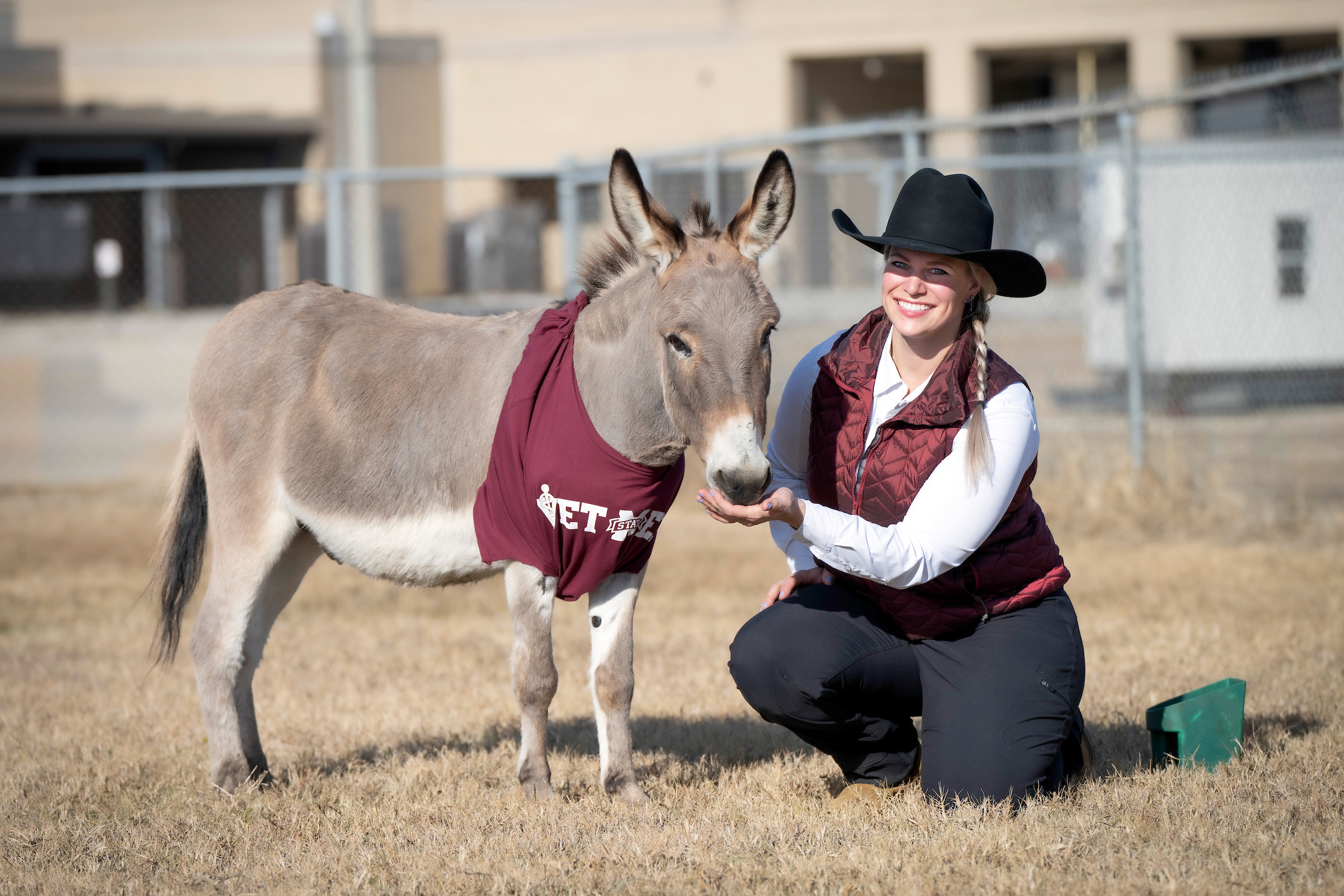
Following surgery, Pico remained at MSU CVM for 12 weeks of recovery. Swales led daily wound care with the help of veterinary students, who ensured Pico received constant attention and care. During that time, he gained an accessory that quickly became his signature look, a Mississippi State T-shirt.
But Pico’s wardrobe choice wasn’t a fashion statement.
His shirt played an important role in protecting the surgical site on his chest, helping keep the wound clean, covered, and free from irritation during the healing process. The “very well-dressed donkey” quickly became a campus favorite.
“Seeing his progress was nothing short of inspiring,” said Swales. We bonded through daily bandage changes and recovery care. He was an absolute joy to work with.”
Pico’s treatment plan extended beyond traditional medicine. In addition to surgery, vaccination, and immune support therapies, the team, in consultation with Dr. Caitlin O’Shea, incorporated an herbal supplement rooted in Chinese medicine theory to support immune function.
Today, Pico’s mass has been reduced by more than 80 percent, while he may require additional care, his quality of life has improved dramatically, and his future looks far brighter.
Beyond recovery, Pico has played an essential role in veterinary education. His case will serve as the foundation for Whitmore’s senior project, and his time at MSU CVM has impacted countless students’ training experiences.
“I was the original student on Pico’s case, Whitmore said. “I did his initial intake and treatment plan in August when he was still a medicine case. I was able to participate in the initial biopsy and stay in the case when he was transferred to surgery. With Pico, I had hands-on experience with the debulking surgery and performing the autologous vaccination. Between this and the hours spent caring for him afterward, it’s an experience I will never forget. Pico, Dr. Wenzel, and Dr. Swales made an enormous impact on my vet school experience and the kind of doctor that I want to be.”