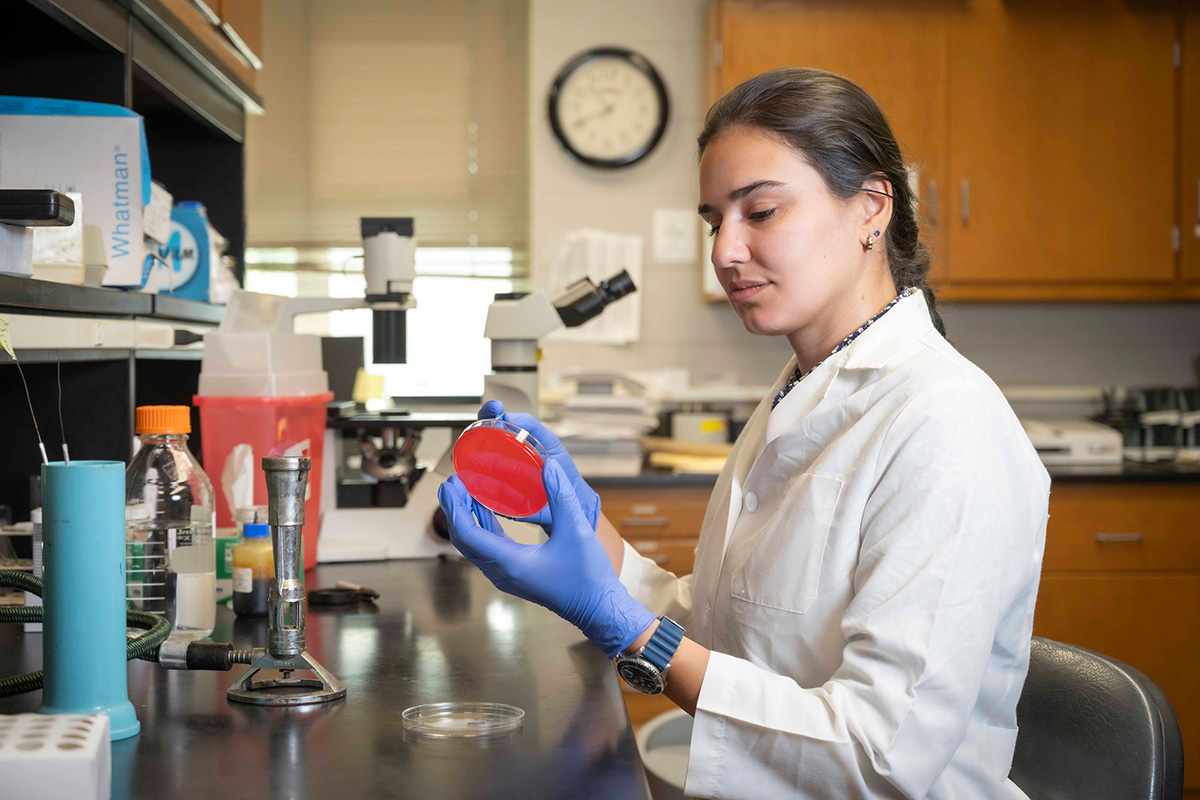
In the heart of the Mississippi Delta, Dr. Muaral Sowlat is quietly making big ripples in the world of aquatic animal health.
Based at Mississippi State University’s Delta Research and Extension Center in Stoneville, Sowlat brings her wealth of knowledge and research skills to her work in aquatic pathology, specifically the diseases that impact Mississippi’s catfish industry.
“My interests are very pathology-focused,” Sowlat says. “I'm always drawn to understanding how diseases evolve over time, and how we can prevent them, and what that means for producers.”
One of her most in-depth projects examines Edwardsiella ictaluri, the bacterial culprit behind enteric septicemia of catfish (ESC), a major disease threat in aquaculture. By digging through nearly two decades of case records dating back to 2007, Sowlat tracked how the bacteria’s responsiveness to antibiotics has changed over time.
“There was an increase in less responsive cases between 2014 and 2022,” she says. “But now, those numbers are trending back down. Resistance is rare again.”
That rebound, she says, likely stems from a combination of new regulations, antibiotics moving under veterinary oversight in 2017, and a groundbreaking ESC vaccine developed at the Stoneville station around 2019. It’s a clear case of how research and policy can work hand in hand to support producers.
But vaccinating fish isn’t quite as straightforward as giving your pet a shot at the vet’s office. Traditional injection methods are too labor-intensive for large-scale catfish farming.
“The game-changer was developing an oral vaccine,” Sowlat says. “Research here found a way to spray the vaccine onto feed, so fish get vaccinated while eating in the pond. It allows for much better coverage with way less labor.”
The innovation is already reshaping how disease is managed and prevented in Mississippi ponds.
Sowlat’s work doesn’t stop at ESC. She’s bringing a new research project on Flavobacterium columnare, the bacteria behind columnaris disease, another major concern for catfish farmers. In particular, she is exploring whether minor mouth injuries from feed pellets might leave fish more susceptible to infection.
“There’s a financial incentive for farmers to switch to larger pellets sooner,” she says. “Smaller pellets are more expensive. But if larger pellets cause oral abrasions that lead to disease, it could cost more in the long run.”
This project, inspired directly by a producer’s question just weeks into Sowlat’s arrival in Stoneville, shows her commitment to applied science, research that serves real-world needs.
“Hopefully, we’ll be able to fine-tune recommendations for when to switch pellet sizes based on fish growth and disease risk.”