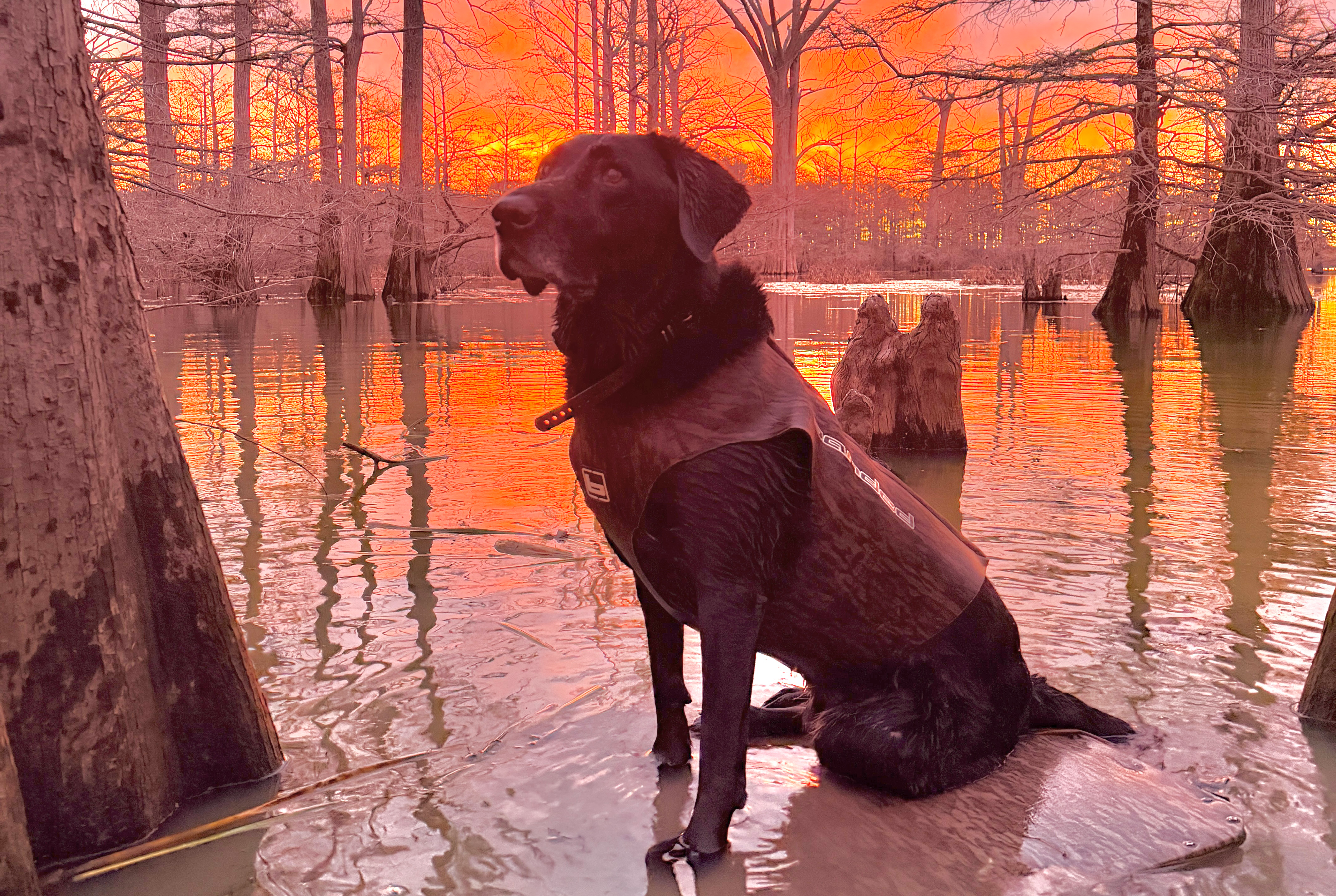
When Rocko, a 9-year-old Labrador retriever with an unmatched love for retrieving, ran across a dove field in the Mississippi Delta last fall, it seemed like any other hunt. But on Sept. 18, 2024, a sudden yelp stopped the day in its tracks.
His owner, Nathan MacNealy, rushed to Rocko, expecting to find a thorn in his paw. Instead, he found something much worse.
“I didn’t see anything in his foot, but I knew something wasn’t right,” MacNealy said. “I loaded him into the truck to head back to Jackson, and his eyes never left that field. That’s when I promised him, I’d do whatever it took to get him back out there.”
A consultation soon confirmed Rocko had torn his left cranial cruciate ligament, or CrCL, the canine equivalent of an ACL in humans. Unsure whether Rocko would ever return to the field, MacNealy turned to the Mississippi State University Animal Emergency and Referral Center, or AERC, his alma mater’s veterinary referral hospital.
“There were other options, but we chose AERC because Dr. Seth Kettleman came highly recommended, they were local, and they offered rehab in-house,” MacNealy said. “From the very first appointment, they made us feel right at home. I knew we were in the right place.”
Kettleman, assistant clinical professor of small animal surgery and chief of specialty services at AERC, performed a tibial plateau leveling osteotomy, or TPLO, on Rocko’s left knee on Sept. 26, 2024. The advanced surgical technique is commonly used to stabilize the knee after cruciate ligament injury, helping dogs return to high levels of activity.
Rocko immediately began in-clinic rehab at the AERC, working closely with the rehabilitation team. His treatment included underwater treadmill therapy and targeted strengthening exercises. The goal was ambitious: return to hunting in time for duck season in November.
Rocko was recovering well, but, unfortunately, the disease affected another of the dog’s knees.
“About 50 percent of dogs with cranial cruciate ligament disease will rupture the ligament in the other knee within one to two years,” Kettleman said. “And Rocko followed the textbook.”
A second TPLO surgery was performed Jan. 30, 2025, and Rocko once again re-entered rehabilitation, which included at-home strength training to build back the dog’s endurance and stability.
“We basically lived rehab,” MacNealy said. “We worked all summer with our sights set on the 2025 season.”
The hard work paid off.
By September, Rocko was back in the field doing what he loves most, retrieving. During dove season alone, he picked up over 100 birds. Now he has turned to the AERC once more, not for surgery, but for a specialized conditioning program as he prepares for this upcoming duck season.
“Green heads are his favorite,” MacNealy said. “And we’re counting down the days.”
Kettleman says Rocko’s case represents the very best of specialty veterinary medicine: advanced surgery paired with comprehensive rehab and a committed owner.
“Rocko’s success is the result of teamwork,” Kettleman said. “From surgery to rehab to follow-up condition, everyone, including his owner, played a role. We are so proud of him.”
MacNealy agreed.
“Rocko isn’t just a dog. He’s family. Dr. Kettleman, Dr. Byrd, Kelsie, and Amanda were right there with us the whole way. We truly could not have done this without them at AERC.”